Opening the case study
One moment…
Getting the project ready for you.
Collaborative Learning and Study Session Platform
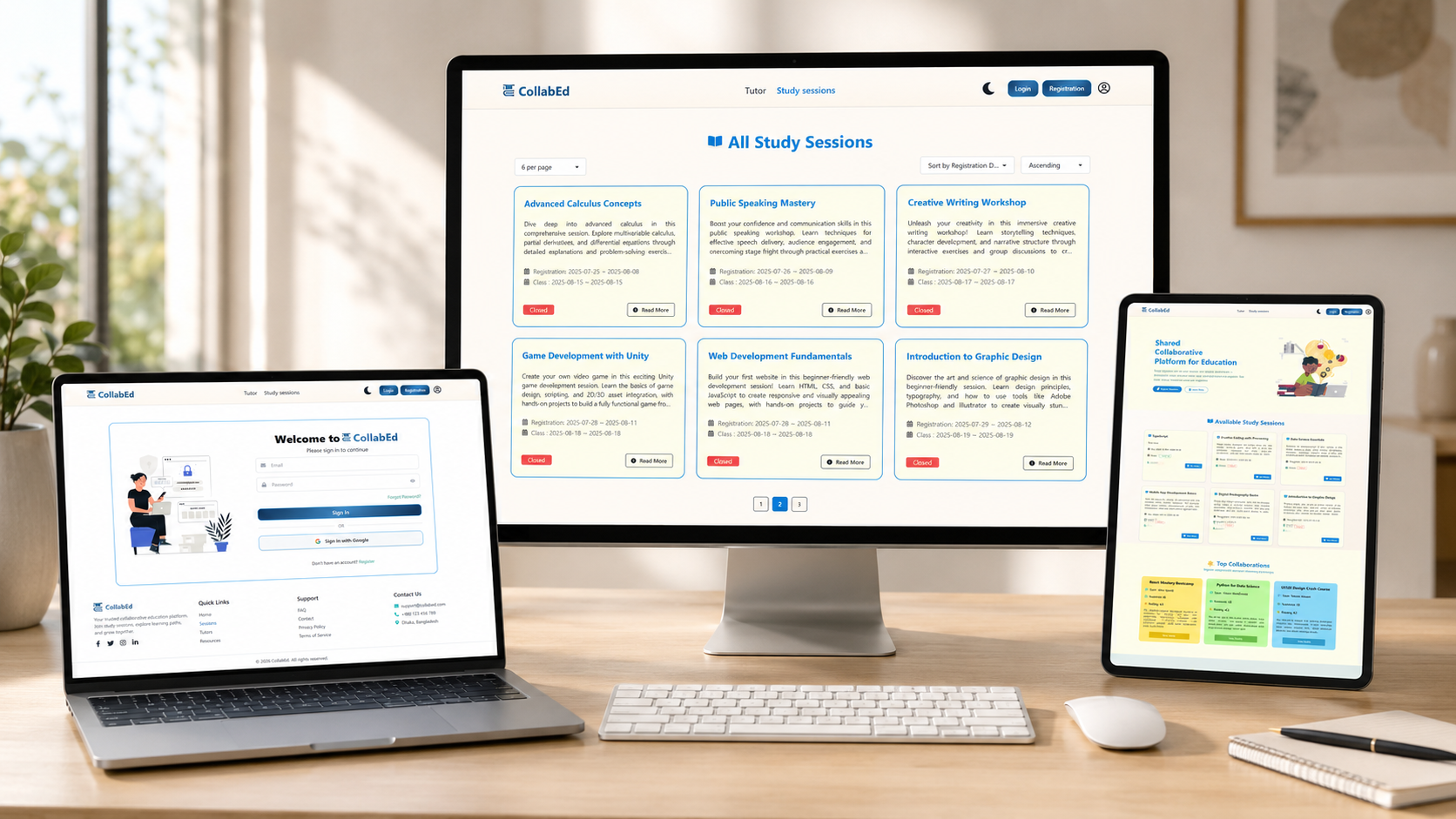
CollabEd is a full-stack collaborative learning and online tutoring platform that connects students with tutors through structured study sessions, educational resources, personal notes, secure payments, and role-based management tools. The application provides dedicated dashboards for administrators, tutors, and students, allowing each user type to access the features and information relevant to their responsibilities. Tutors can create study sessions, manage their submitted sessions, upload educational materials, and review the status of their content.
Newly created sessions follow an approval workflow in which administrators can review, approve, or reject them with a reason and feedback. Students can browse approved sessions, view detailed session information, book free or paid sessions, access learning materials, maintain personal study notes, manage their bookings, and submit ratings and reviews after participating in a session. Administrators receive a centralized dashboard for managing users, study sessions, and uploaded materials.
The system uses Firebase Authentication on the client and Firebase Admin token verification on the server to protect selected resources and verify that authenticated users are requesting their own data. Stripe is integrated for card payments, while MongoDB stores user accounts, study sessions, bookings, materials, personal notes, and review information. The frontend includes responsive layouts, light and dark themes, interactive dashboards, charts, animated components, form handling, cached API requests, notifications, password recovery, Google authentication, profile management, and protected role-specific routes.
These features make CollabEd suitable for peer-learning communities, independent tutors, academic mentoring programs, and small online learning organizations.
One of the primary challenges in developing CollabEd was designing and coordinating three separate user experiences for administrators, tutors, and students while maintaining a shared authentication system and consistent interface. Each role required its own protected dashboard, navigation, permissions, and data queries. Tutors needed to create sessions and upload materials, administrators needed to approve or reject those sessions and moderate platform data, and students needed to browse, book, pay for, and review approved sessions.
Managing this complete workflow required careful coordination between Firebase authentication, React route protection, server-side token verification, MongoDB collections, and role-specific API requests. Another major challenge was maintaining consistency between session approval, booking, payment, materials, notes, and review records. Only approved sessions should appear in the public catalogue, while paid sessions require successful Stripe payment before the booking process is completed.
The platform also needed to retrieve user-specific bookings and notes securely, associate uploaded materials with the correct tutor or session, prevent unauthorized data access, and update review information against the appropriate student booking. Implementing pagination and sorting for approved sessions, responsive dashboards, loading states, notifications, profile updates, and reusable data-fetching logic added further complexity to the overall application.
Future development of CollabEd will focus on making the platform a more complete virtual learning environment. Planned improvements include real-time notifications for session approvals, booking confirmations, schedule changes, uploaded materials, and tutor feedback. Direct messaging, group discussions, live chat, integrated video classes, calendar synchronization, attendance tracking, and automatic session reminders could improve communication between tutors and students.
The platform could also introduce recurring sessions, class-capacity limits, waiting lists, discount codes, subscription plans, tutor availability calendars, downloadable invoices, payment histories, refunds, and automated tutor payouts. The learning experience can be expanded with assignments, quizzes, progress tracking, course bundles, completion certificates, resource previews, cloud-based file uploads, bookmarks, searchable materials, collaborative notes, and personalized session recommendations. Technical improvements should include consistent authorization middleware across every protected operation, dedicated role-verification middleware, request-schema validation, duplicate-booking prevention, Stripe webhook verification, rate limiting, centralized error handling, database indexing, and audit logs.
Refactoring the backend into separate routes, controllers, services, models, and middleware would also improve maintainability. Additional plans include automated unit and integration testing, CI/CD pipelines, API documentation, application monitoring, multilingual support, stronger accessibility compliance, Progressive Web App functionality, and dedicated mobile applications.